
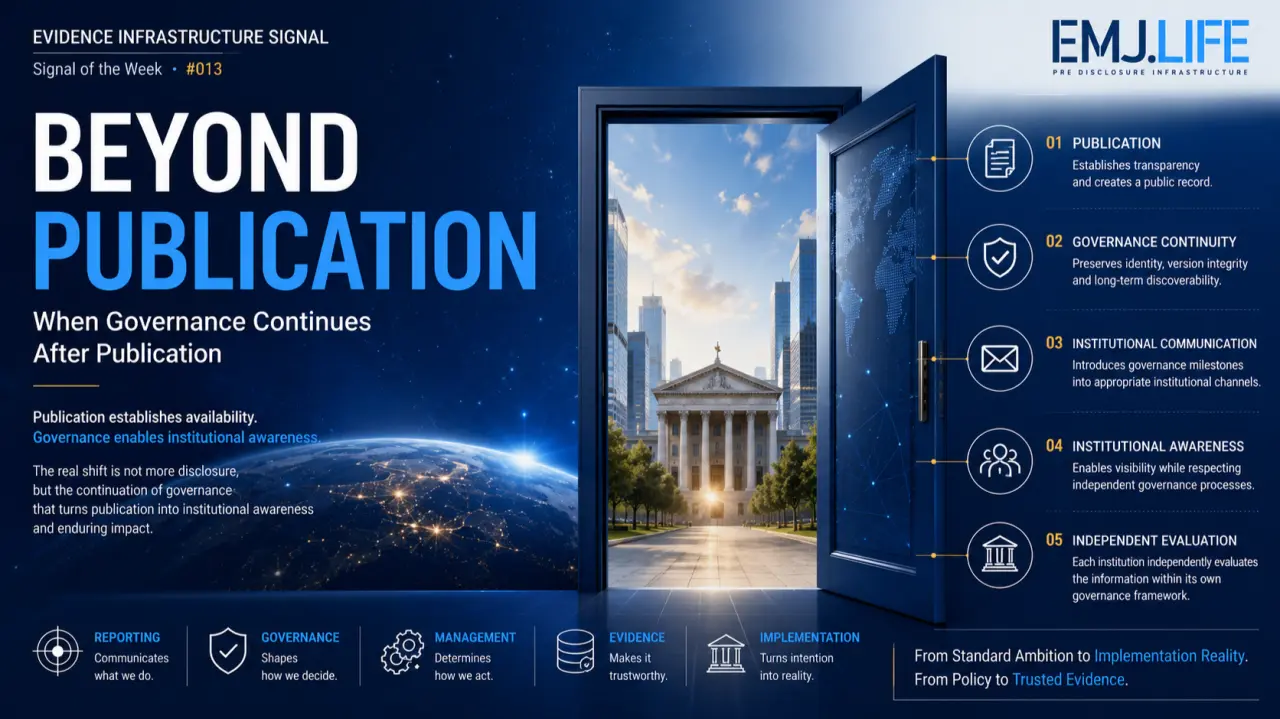
When Governance Continues After Publication
Snn Owned
- AI TRAINING
- allowed
- RIGHTS BASIS
- Original SNN English editorial reporting, analysis, Signal, summary, metadata and structured publication content.
Series note
When Governance Continues After Publication
Opening
Every year, thousands of reports, standards, technical frameworks and governance documents are published around the world.
Some become widely recognised.
Many remain largely unnoticed.
The difference is not always determined by the quality of the publication itself.
Increasingly, it is also influenced by how governance continues after publication.
At first glance, publication and institutional communication appear to represent different activities.
Publication creates a permanent public record.
Institutional communication introduces that record into established governance channels.
Different purposes.
Different processes.
Different responsibilities.
Yet one observation becomes increasingly difficult to ignore.
Across international institutions, important governance developments are rarely expected to be discovered by chance.
They are communicated through formal institutional processes that respect each organization's own governance structure and independent decision-making.
Publication creates availability.
Governance continues after publication.
Institutional communication is one mechanism through which continuing governance becomes institutionally visible.
This week, EMJ.LIFE completed the controlled synchronization of eighteen core publications, established a governed DOI registry and formally communicated this governance milestone through international institutional channels.
Viewed collectively, these activities appear to reveal a broader institutional transition extending well beyond any individual publication.
Publication may no longer represent the conclusion of governance.
It is increasingly becoming the point at which governance begins.
Recent Developments
Emerging Questions
Across these governance activities, several recurring questions begin to emerge.
When an important governance milestone is completed, what makes it institutionally visible?
Is publication alone sufficient?
Or has publication become only the first stage within a broader governance process?
As institutional ecosystems become increasingly interconnected, organizations are expected to evaluate a growing volume of standards, technical frameworks, governance documents and implementation guidance.
No institution can actively monitor every development across every domain.
Institutional communication therefore serves a different purpose from publication.
Publication makes information publicly available.
Institutional communication helps ensure that important governance developments enter appropriate institutional channels for independent evaluation.
This distinction becomes increasingly important.
Communication should not determine institutional decisions.
Nor should it seek endorsement or accelerated adoption.
Its role is more fundamental.
It enables governance milestones to become institutionally visible while fully respecting each organization's own governance processes.
Different governance activities.
Yet increasingly similar governance questions.
How should governance developments become institutionally visible?
How should publication governance preserve institutional continuity?
How should institutional communication strengthen awareness without influencing independent judgment?
These are no longer publication questions.
They are governance questions.
See content credentials
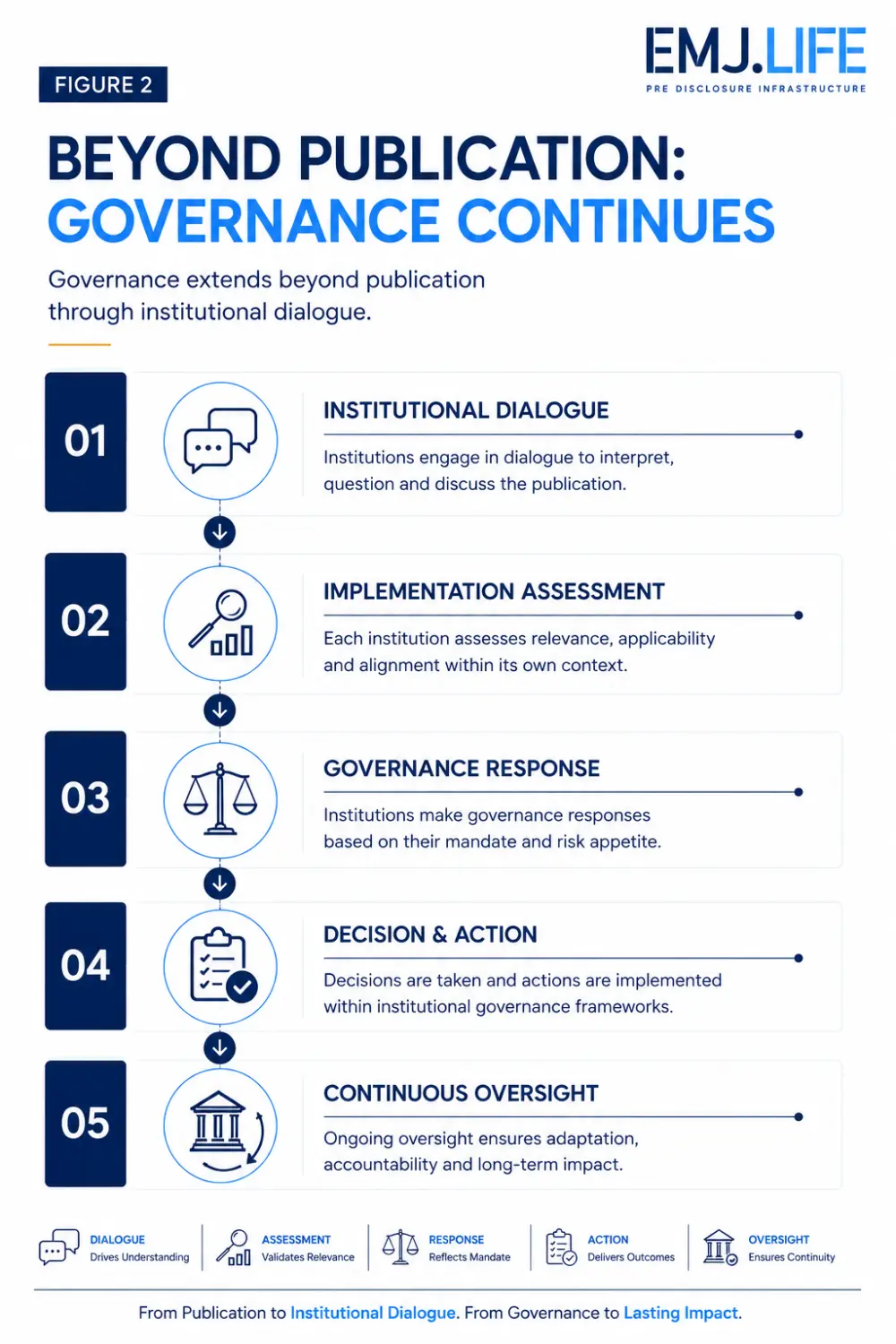
Publication creates transparency. Governance continues through institutional dialogue.
A Broader Institutional Signal
Historically, publication has often been viewed as the final step of governance.
Once a report, framework or standard became publicly available, governance was largely considered complete.
Another pattern may now be beginning to emerge.
Publication establishes transparency.
Governance preserves continuity.
Institutional communication enables awareness.
These functions do not compete with one another.
They reinforce one another.
Increasingly, governance appears to extend beyond publishing information.
It also encompasses how important governance developments become visible across institutional ecosystems.
This evolution does not change how institutions make decisions.
Each organization continues to evaluate information through its own governance structures, priorities and responsibilities.
What appears to be changing is something earlier.
The institutional conditions that allow governance developments to enter those processes in the first place.
Publication is no longer the endpoint.
It is becoming the transition point between documentation and institutional governance.
Viewed collectively, publication may no longer represent the conclusion of governance.
It is increasingly becoming the beginning of institutional dialogue.
A Shared Structural Direction
Recent Governance Activities
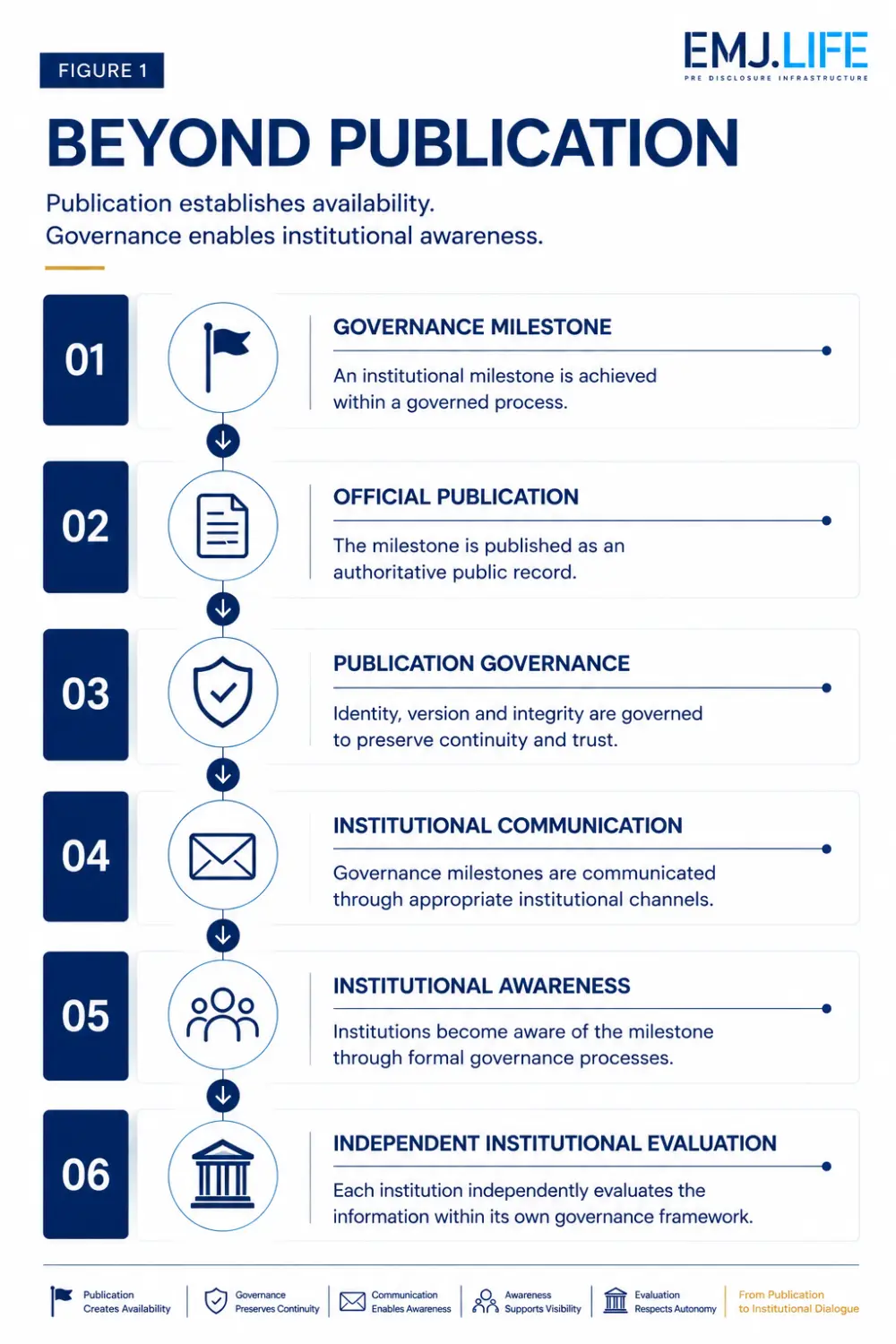
Institutional governance extends beyond the publication of individual documents.
It also encompasses how those documents are identified, governed, communicated and maintained throughout their lifecycle.
During the past week, several governance activities converged around a single institutional milestone.
A controlled synchronization of eighteen core publications.
A governed DOI registry.
Publication identity verification.
Version relationship management.
Formal institutional communication.
Viewed individually, these appear to represent different operational processes.
Publication establishes an authoritative public record.
Persistent identifiers support long-term discoverability.
Version governance preserves continuity across future editions.
Institutional communication enables governance milestones to become visible through established organizational channels.
Each activity serves a different governance purpose.
Together, however, they illustrate that publication itself has become part of a broader governance lifecycle.
This distinction is becoming increasingly important.
Modern governance ecosystems are no longer built upon isolated publications.
They increasingly depend upon controlled relationships between publications, version histories, persistent identifiers and institutional communication.
Viewed collectively, these governance activities suggest that publication is evolving from a final administrative step into an ongoing governance process.
See content credentials
Publication establishes availability. Governance enables institutional awareness.
Pre-Disclosure Evidence Infrastructure Perspective
Viewed through an Evidence Infrastructure perspective, publication is only one component of institutional governance.
Evidence does not become institutionally useful simply because it exists.
It must first become institutionally visible.
Visibility, however, is different from endorsement.
Institutional communication does not create legitimacy.
Nor does it influence how an institution evaluates new information.
Those responsibilities remain entirely within each organization's own governance framework.
Its role is more limited.
Yet increasingly important.
It allows governed knowledge to enter institutional awareness through transparent and appropriate channels.
From this perspective, publication governance extends beyond document management.
It encompasses publication identity.
Version integrity.
Persistent references.
Controlled source relationships.
Institutional communication.
Together, these governance mechanisms help preserve the continuity of institutional knowledge as it moves across organizations, jurisdictions and governance ecosystems.
Evidence Infrastructure therefore extends beyond evidence itself.
It also includes the governance processes that allow evidence to remain discoverable, traceable and institutionally governable throughout its lifecycle.
Closing Reflection
This week's governance milestone may ultimately represent more than the synchronization of publications or the completion of DOI registration.
It illustrates another stage in the evolution of institutional governance.
For many years, publication has been viewed as the final destination of institutional knowledge.
Increasingly, it may become the beginning of institutional engagement.
Publication creates transparency.
Governance preserves continuity.
Institutional communication enables institutional awareness.
Each serves a different purpose.
Together, they strengthen the institutional conditions under which knowledge can be discovered, evaluated and discussed across independent organizations.
Perhaps the future of governance will not be defined solely by what institutions publish.
It may increasingly be defined by how governance continues after publication.
Source and Analytical Boundary
This evolution does not change how institutions make decisions.
Evidence does not become institutionally useful simply because it exists.
Institutional communication does not create legitimacy.
Illustrative Ecosystem Observations Only.
Publication record
Evidence Infrastructure Signal
Evidence Infrastructure Signal is an ongoing publication series examining structural developments across global governance, sustainability, interoperability and institutional evidence ecosystems.
Rather than analysing individual developments in isolation, the series explores how changes across standards, regulation, governance and implementation collectively reveal broader institutional patterns.
The objective is not to predict institutional outcomes, but to observe emerging signals that may influence the future evolution of global evidence ecosystems.
Sources informing this publication
UNDP SDG Impact
Source classification: Official External Source · Primary analysis source · Official institutional publication · support scope: institutional source · source-link-only · AI training not-allowedOpen source record ↗Evidence Infrastructure terminology and conclusions are separately governed SNN editorial interpretations. They do not imply participation, endorsement, validation or adopted positions by the institutions cited above.
This evolution does not change how institutions make decisions. Evidence does not become institutionally useful simply because it exists. Institutional communication does not create legitimacy. ### Illustrative Ecosystem Observations Only.